
Affiliate disclosure: As an Amazon Associate I earn from qualifying purchases. CleverlyFound may earn a commission from qualifying purchases through Amazon Associates.
What adjustable drawer dividers actually do
Adjustable drawer dividers create separate spaces inside an existing drawer. They can help keep utensils, stationery or other small household items in more predictable positions. However, they cannot increase the drawer itself. A divider takes up some space, so its thickness matters as well as its length.
The aim is to make the contents easier to reach, not to fill every gap with another accessory. First, empty the drawer and work out which items belong there. Then, consider whether straight compartments would suit the shapes you need to store. Some drawers work well with a few long sections, while others benefit from individual trays.
1. Measure the usable space
Measure the inside of the drawer rather than the cabinet front. Record the usable width, depth and height. In addition, check the narrowest points because runners, handles or internal fittings may reduce clearance. Measure at both ends if the drawer shape looks uneven.
A divider designed to extend between two walls needs sufficient room to sit securely without forcing those walls apart. Therefore, compare your measurements with the listed minimum and maximum extension. Check the height too, especially if the drawer sits below a shallow bench. A ruler, tape measure and a simple sketch can help you compare options before choosing.
2. Consider the adjustment mechanism
Expandable designs use different mechanisms to maintain their length. Some use spring pressure, while others have a locking or sliding arrangement. However, the presence of a mechanism does not establish how well it will hold under everyday movement. Read the instructions and look for information about suitable surfaces and recommended installation.
A spring-loaded design may suit a straightforward rectangular drawer. A modular arrangement may instead help create smaller compartments around mixed objects. In either case, make sure you can release or move components without damaging the drawer. If the drawer walls are thin or delicate, follow the manufacturer’s guidance rather than applying extra pressure.
3. Compare materials and cleaning needs
Bamboo, plastic and metal are common materials for drawer organisation. Each has different practical considerations. Bamboo may appeal to someone who likes a natural finish, but check the recommended cleaning method. Plastic designs may offer smooth surfaces and a range of shapes.
However, construction and thickness vary. Metal pieces may provide a slim profile, depending on the design, but check the edges and contact points. Consider the drawer’s usual contents as well. A kitchen utensil drawer may need more frequent cleaning than a stationery drawer. Before choosing, read the care instructions and check whether protective pads or other parts can be replaced.
4. Check the shape of your belongings
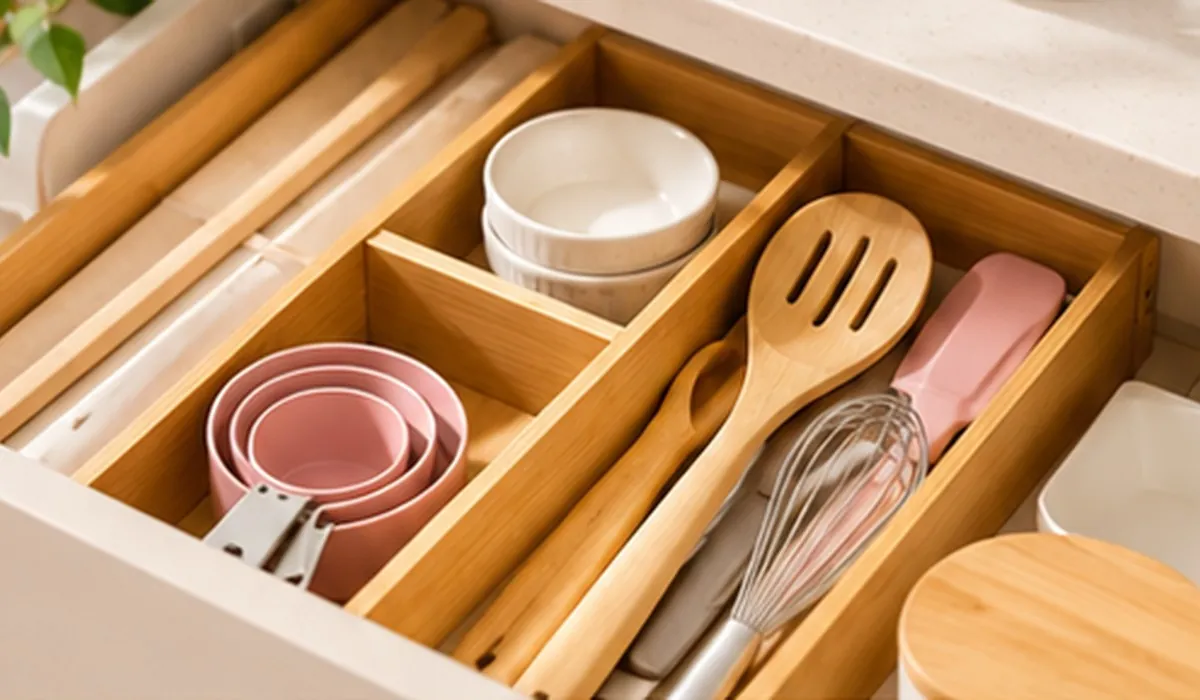
A clever layout follows the objects rather than forcing objects into equal spaces. For example, long spatulas need room along their full length, while teaspoons may fit a shorter section. First, group similar items on a bench. Then, arrange them roughly as you would inside the drawer.
Notice which pieces overlap or catch on one another. A wide compartment may suit larger cooking tools, while a narrow section might hold smaller accessories. Alternatively, a removable tray can help contain objects that move freely. Leave a little room for fingers to reach each group without disturbing everything beside it. An overly tight arrangement can become frustrating.
5. Look at contact points and drawer protection
Dividers often touch two opposing drawer surfaces. As a result, the contact material deserves attention. Look for information about end pads, non-slip surfaces and the pressure required for installation. Do not assume every pad suits every finish.
For example, a painted drawer and an unfinished timber drawer may have different care requirements. Follow the supplied directions and avoid improvising with strong adhesives. Likewise, check that the divider does not obstruct the drawer runners or prevent closure. A design that requires force to install may not suit your drawer. If the product dimensions or fitting instructions are unclear, seek clarification before choosing it.
6. Plan for changing routines
Adjustable drawer dividers may be useful because the arrangement can change. A household might add a utensil, move stationery or reorganise a shared space. However, flexibility depends on the actual design and the room available. Check whether you can reposition pieces individually or must dismantle the whole arrangement.
In addition, consider whether spare components are available if the system uses connectors. A simple set of straight dividers may work well for a stable collection of items. Conversely, a modular tray may suit a drawer with many small objects. The choice depends on how often you expect the contents to change.
7. Decide whether a divider is necessary
Sometimes a drawer needs fewer items rather than more compartments. For example, duplicate utensils can make a shallow drawer difficult to close even after you separate them. Start by removing objects that belong elsewhere. Next, keep frequently used items within easy reach.
If the remaining objects already sit comfortably in an existing tray, a new divider may add little value. On the other hand, a drawer containing several long tools could benefit from clear boundaries. Compare a divider with a removable container or an arrangement you already own. The useful option is the one that addresses your particular storage problem.
A sensible layout for common drawers
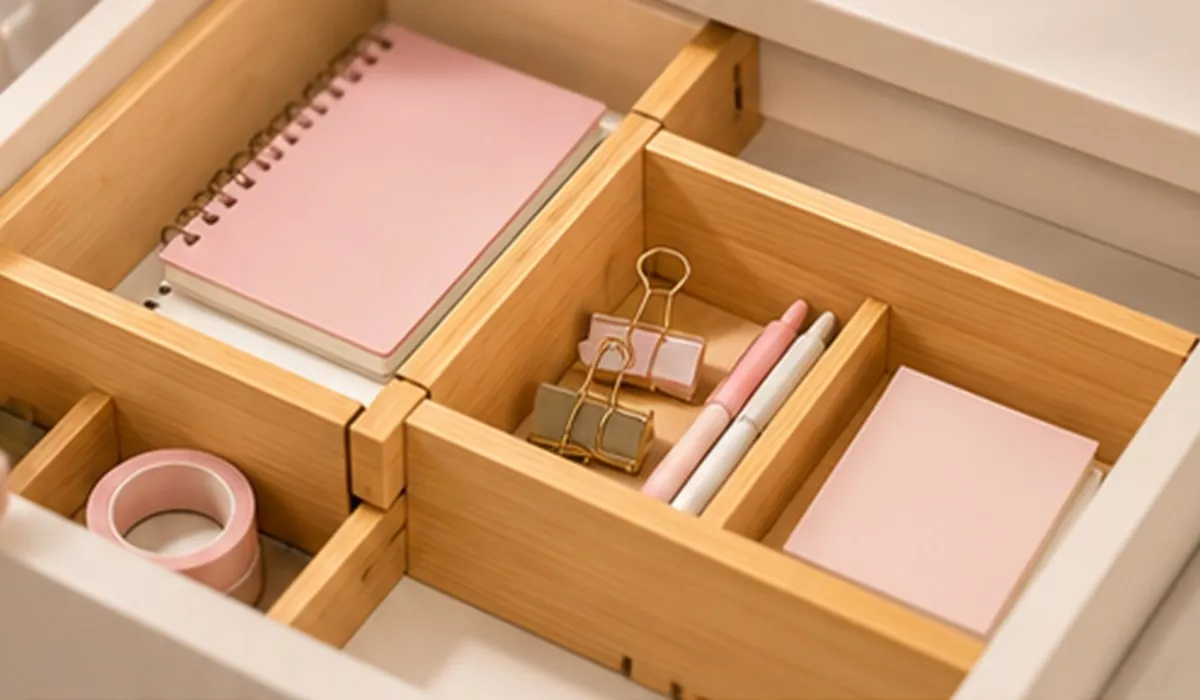
For a kitchen utensil drawer, consider one long section for cooking tools and another for smaller pieces. However, keep sharp objects in suitable protective storage and follow safe handling practices. For a desk drawer, separate writing tools from clips, cables and other accessories. Small containers may help prevent tiny items from slipping between dividers.
A bathroom drawer may benefit from washable trays if its contents need regular cleaning. In each setting, measure the space and check relevant material care instructions. Start with a small number of compartments. Afterwards, adjust the arrangement if you notice that frequently used items remain difficult to reach.
How to check clearance before ordering
Draw a rectangle representing the usable drawer area, then mark the positions of any fixed objects or fittings. Next, use the listed thickness and extension range of the divider to sketch possible compartments. This gives you a rough sense of how much room remains for belongings.
For example, two thick dividers might reduce the width of a small drawer more than expected. A taller divider might also interfere with objects that extend above the drawer sides. Check every dimension against the actual product information. A paper sketch cannot confirm compatibility, but it can help identify questions to ask before choosing.
Avoid creating awkward compartments
An arrangement with many narrow sections can look orderly yet feel difficult to use. Therefore, allow room around frequently handled objects. If a compartment is just wide enough for a utensil, your fingers may have limited space to grasp it. Similarly, stacked objects might hide smaller ones beneath them.
Consider placing items according to how frequently you use them. For example, everyday cooking tools could occupy one easy-to-reach section, while occasional accessories sit further back. Revisit the layout after using the drawer normally. If you repeatedly move a divider to reach something, a wider compartment or a different layout may suit you.
Keep maintenance in mind
Drawers can collect crumbs, dust and small debris over time. Consequently, consider whether an organiser can be removed or repositioned for cleaning. Follow the care instructions for the materials and avoid soaking items unless the manufacturer permits it.
Check that components have dried appropriately before returning them to the drawer. Also, inspect contact pads and fittings periodically if the instructions recommend it. A design that is easy to maintain may be more convenient for a busy household than one with many inaccessible corners. The aim is an arrangement that remains practical, not just one that looks attractive on the first day.
A quick example for an awkward kitchen drawer
Suppose you have a drawer with long cooking utensils and several small measuring spoons. First, lay out the larger items along the direction that gives them the most room. Next, check how much space remains for the smaller pieces. A single adjustable divider might create a useful boundary between these two groups. However, if the small items slide around, a separate shallow container could serve them better.
Compare the combined footprint of both accessories with the usable space. Also, check whether the drawer closes comfortably when the longest utensils sit inside it. This example does not require a complete matching set. Instead, it shows how different organisation methods can work together when each addresses a specific need. The arrangement may change as you use the kitchen.
Final thoughts on choosing adjustable drawer dividers
Adjustable drawer dividers suit readers who want clearer boundaries inside an existing drawer. The most important checks involve usable dimensions, adjustment mechanisms, contact surfaces and the shapes of the items you store. However, an attractive layout alone cannot guarantee that the arrangement will work for your household.
Check the current product specifications and installation guidance before purchasing. A simple layout with enough room to reach your belongings can be more useful than a tightly packed system. Ultimately, a little order goes a long way when the arrangement makes ordinary tasks easier. Choose the design that fits your space, not the picture of someone else’s drawer.